Used Grist Mill Plant for sale (12,573)
Sort results
- Lowest price Highest price
- Newest listings Oldest listings
- Shortest distance Farthest distance
- Newest year of manufacture Oldest year of manufacture
- Latest update Oldest update
- Manufacturer A to Z Manufacturer Z to A
- Relevance
- Lowest price
- Price
- Highest price
- Price
- Newest listings
- Release date
- Oldest listings
- Release date
- Shortest distance
- Distance
- Farthest distance
- Distance
- Newest year of manufacture
- Year of construction
- Oldest year of manufacture
- Year of construction
- Latest update
- Update
- Oldest update
- Update
- Manufacturer A to Z
- Manufacturer
- Manufacturer Z to A
- Manufacturer
- designation from A to Z
- Description
- designation from Z to A
- Description
- Model from A to Z
- Model
- Model from Z to A
- Model
- Lowest reference
- Ref.No.
- Highest reference
- Ref.No.
- Shortest runtime
- Runtime
- Longest duration
- Runtime
- Relevance
- Relevance
Listing
Freising
1,296 km
Grist mill plant
Künzel (Schrotmühle)
Call
Condition: used, Plant for the conditioned milling of malt into grist and for the subsequent storage of the grist. In a conditioning screw conveyor, the malt is moistened with water at 60°C before being ground into grist in the 6-roll mill (Künzel, 1966). The conditioning water is pre-treated in a water treatment system (Täuber, 2019). The grist is collected in a funnel-shaped grist hopper mounted on legs and fed into the grist transport system.
Additional title: 6-roll mill for conditioned dry grinding; built between 1966 and 2019
Capacity: 1200 kg/h
Tedpfx Aeziy U Donleb
Features: 6-roll mill; conditioning screw; water treatment
Listing
Zheng Zhou Shi
8,333 km
Crushing equipment
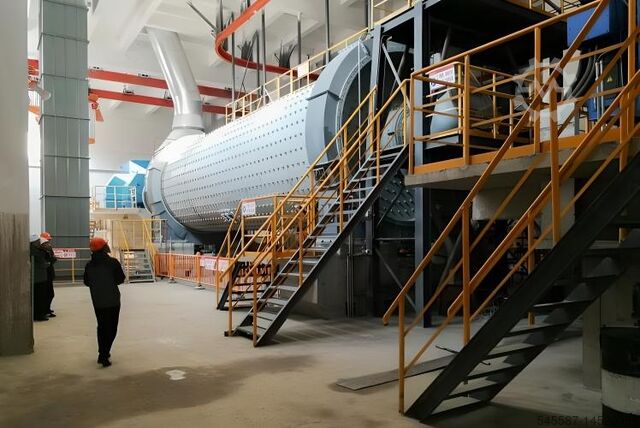
Mingyuan Dry and Wet Ball MillCustomerizable Model for ball mill plant
Call
Condition: new, functionality: fully functional, Year of construction: 2026, Dry and Wet Ball Mill: Structure, Operation, and Technical Details
A ball mill is a fundamental grinding device used in mineral processing, cement manufacturing, chemical production, and other industrial applications. It works by rotating a cylindrical shell filled with grinding media—usually steel balls—causing impact and friction that reduce materials to fine powder. Based on the grinding environment, ball mills are classified into dry and wet types, each suited for specific materials and process requirements.
Working Principle
Both dry and wet ball mills operate on the same mechanical principle. The rotating cylinder, driven by a motor through a gear system, lifts the grinding media and material along the inner wall. As the rotation continues, the balls fall under gravity, striking and grinding the material. The difference lies in the presence or absence of a liquid medium during grinding.
Tedpsq Nx Alsfx Anlob
Dry Ball Mill
A dry ball mill is used when the material must remain moisture-free or when water could affect product quality. It is commonly applied in cement clinker, limestone, quartz, and refractory material grinding. The discharge can be either grate type or overflow type, depending on the desired fineness.
Technical Features:
Feeding size: ≤25 mm
Discharge size: 0.075–0.4 mm
Capacity: 0.65–90 t/h
Liner material: High manganese steel or wear-resistant alloy
Drive system: Gear-driven or direct-coupled motor
Dust control: Equipped with air exhaust and dust collector
Advantages:
Suitable for materials sensitive to moisture
No drying process required after grinding
Lower corrosion risk and simpler maintenance
Easier material classification and separation
Limitations:
Dry grinding produces more dust and heat, requiring efficient ventilation and dust collection systems.
Wet Ball Mill
A wet ball mill operates with water or another liquid medium added to the material. The slurry formed during grinding improves efficiency by reducing friction and preventing excessive heat buildup. It is widely used in ore beneficiation, ceramics, and chemical industries.
Technical Features:
Feeding size: ≤25 mm
Discharge size: 0.074–0.2 mm
Capacity: 0.65–615 t/h
Liner material: Rubber or high-chromium steel
Discharge method: Overflow or grate type
Auxiliary equipment: Classifier, pump, and thickener for slurry circulation
Advantages:
Higher grinding efficiency and finer particle size
Reduced dust and noise levels
Continuous operation suitable for beneficiation circuits
Better control of particle uniformity
Limitations:
Requires drying if the final product must be in powder form and involves more complex slurry handling.
The selection between dry and wet grinding depends on the material characteristics, downstream process, and environmental conditions. Dry mills are preferred for materials that must stay moisture-free, while wet mills are ideal for fine grinding and slurry-based processes.
Conclusion
Dry and wet ball mills share the same mechanical structure but differ in their grinding environment and application scope. The dry type offers simplicity and low maintenance for moisture-sensitive materials, while the wet type provides higher efficiency and finer output for mineral and chemical processing. Understanding their technical parameters and operational differences ensures optimal equipment selection, improved productivity, and reliable performance in industrial grinding operations.
Listing
Zheng Zhou Shi
8,333 km
Powder grinding mill
ball mill for mining &fine powder makingsilica/Barite/limestone powder plant
Call
Condition: new, Year of construction: 2026, power: 300 kW (407.89 HP), Ball Mill for Mining & Fine Powder Making:
A ball mill is a fundamental grinding device widely used in mining, metallurgy, cement, and chemical industries. It is designed to grind ores and other materials into fine powder through impact and attrition between steel balls and the material inside a rotating cylindrical shell. In mining plants, ball mills are essential for ore beneficiation, while in powder-making industries, they ensure uniform particle size and high surface area for further processing.
Working Principle
The ball mill operates on the principle of impact and friction. As the cylindrical shell rotates around its horizontal axis, the grinding media—usually steel or ceramic balls—are lifted along the inner wall by centrifugal force and friction. When they reach a certain height, they fall freely, striking and grinding the material below. This repeated motion breaks down the material into fine particles. The process can be carried out in dry or wet conditions depending on the application.
Structural Composition
A standard ball mill consists of several main components:
Feeding part: Ensures uniform material input through a feeder or screw conveyor.
Discharging part: Can be grate type or overflow type, depending on the discharge method.
Rotating part: The cylindrical shell made of steel plates, lined with wear-resistant liners.
Transmission system: Includes motor, reducer, small transmission gear, and electrical control.
Grinding media: Steel or ceramic balls of various diameters for efficient grinding.
The internal liner design and ball size distribution are optimized to achieve maximum grinding efficiency and minimal energy consumption.
Technical Details/Typical Specifications:
Feeding size: ≤25 mm
Discharge size: 0.074–0.4 mm
Capacity: 0.65–615 t/h (depending on model and material hardness)
Cylinder speed: 18–38 r/min
Power: 18.5–4500 kW
Liner material: High manganese steel, rubber, or alloy steel
Tedpfx Ansq Ngafsleb
Grinding media load: 30–45% of cylinder volume
Operating Modes:
Dry grinding: Used for materials that must remain moisture-free, such as cement clinker, limestone, and quartz.
Wet grinding: Common in ore beneficiation, where water or slurry improves grinding efficiency and particle uniformity.
Application in Mining and Powder Production
In mining operations, ball mills are used after crushing to further reduce ore size and liberate valuable minerals. They are integrated into grinding circuits with classifiers, hydrocyclones, and flotation systems. The ground material is classified by size, and oversized particles are returned to the mill for regrinding. This closed-circuit system ensures consistent product fineness and efficient energy use.
In fine powder production, ball mills are used to produce materials such as silicate, ceramic powder, refractory materials, and chemical raw materials. The uniform particle size achieved by ball milling enhances product quality and performance in downstream applications.
Conclusion
A ball mill is an indispensable piece of equipment for both mining and fine powder making. Its ability to grind materials into fine, uniform particles makes it vital for ore beneficiation and industrial powder production. With flexible configurations, high efficiency, and reliable operation, modern ball mills provide a cost-effective and energy-efficient solution for large-scale grinding, ensuring consistent quality and productivity across diverse applications.

Get information now
+44 20 806 810 84
+44 20 806 810 84
List now
*per listing / month
Listing
Zheng Zhou Shi
8,333 km
Fine Powder Grinding Plant
Cement mill & Ultrafine Grinding MillFine Powder Grinding Plant
Call
Condition: new, functionality: fully functional, Year of construction: 2026, Cement Mill & Ultrafine Grinding Mill
🏗️ Introduction to Cement Mill & Ultrafine Grinding Mill
In the world of construction and materials processing, achieving the right particle size is essential. Introducing the Cement Mill and Ultrafine Grinding Mill—two pivotal machines designed to deliver superior grinding performance for cement production and ultrafine materials. Let’s dive into their features and applications! 💼
🔥 What is a Cement Mill?
A Cement Mill is a crucial piece of equipment in cement production. It grinds clinker, gypsum, and other additives to produce fine cement powder. This machine ensures the optimal particle size for high-quality cement, essential for building robust structures. 🚀
🔧 What is an Ultrafine Grinding Mill?
An Ultrafine Grinding Mill is designed to produce extremely fine powders from various raw materials, such as minerals, chemicals, and industrial waste. It operates at high efficiency, delivering ultra-fine materials for advanced applications like coatings, plastics, and ceramics. 🌟
💼 Key Benefits of Using Cement Mill & Ultrafine Grinding Mill
1. High Efficiency: Both mills are engineered for maximum efficiency, ensuring rapid processing times and reduced energy consumption. 🌿💡
2. Superior Grinding Performance: Achieve consistent, high-quality output with precise control over particle size. 🏭
3. Versatility: Suitable for a wide range of materials, making them essential for various industrial applications. 🌳
4. Durability and Reliability: Built with robust materials, these mills offer long-lasting performance in demanding industrial environments. 💪
📈 Applications in Industry
Cement Mill Applications:
1. Cement Production: Essential for producing high-quality cement for construction projects.
2. Infrastructure Development: Used in creating concrete for roads, bridges, and buildings.
Ultrafine Grinding Mill Applications:
1. Mineral Processing: Producing ultra-fine powders for advanced material applications.
2. Chemical Manufacturing: Used in creating fine chemicals for various industrial processes.
3. Environmental Applications: Grinding industrial waste for recycling and reuse. ♻️
🌟 Conclusion
Tedoq Nyydspfx Anljb
Whether you’re in construction, materials processing, or advanced manufacturing, the Cement Mill and Ultrafine Grinding Mill are indispensable tools. Their efficiency, versatility, and superior performance make them a valuable addition to any production line. Contact us today to learn more about these innovative machines and how they can revolutionize your operations! 📞
Listing
Zheng Zhou Shi
8,333 km
Roll forming line
Rod ball mill / Rod Grinding MillFor Sand and mining beneficiation plant
Call
Condition: new, Year of construction: 2026, We have various kinds of ball grinding mill such as batch ball mill, rod mill, cement ball mill, mining ball mill, welcome to contact our team for further details according to your specific requirements.
Tjdpsq I Nw Isfx Anlob
Listing
Zheng Zhou Shi
8,333 km
Grinding mill
Abrasive Aluminium Oxide Grinding PlantMicrosilica powder Grinding Mill
Call
Condition: new, functionality: fully functional, Year of construction: 2026, Microsilica, also known as silica fume or condensed silica fume, is a byproduct of producing silicon metal or ferrosilicon alloys. Microsilica powder grinding mills are used to process microsilica powder for various applications, including the production of high-performance concrete, refractory materials, and other specialty products. Grinding mills play a crucial role in reducing microsilica particles to the desired fineness. Here are some key aspects related to microsilica powder grinding mills:
1. Mill Types:
- Ball Mill: A traditional ball mill is commonly used for grinding microsilica. It relies on the impact and attrition forces to reduce particle size. It is effective for both wet and dry grinding.
- Vertical Roller Mill (VRM): VRM technology is known for its energy efficiency and the ability to grind materials into a narrow particle size distribution. It is suitable for grinding microsilica.
2. Grinding Process:
- The grinding process involves feeding microsilica particles into the grinding mill. The grinding media (balls or rollers) inside the mill crush and grind the microsilica particles into a fine powder.
3. Particle Size Distribution:
- Controlling the particle size distribution is crucial for achieving the desired properties in the final product. The grinding mill should be equipped with mechanisms to control and monitor particle size distribution.
4. Mill Design and Components:
- The design of the grinding mill, including the type of grinding media, liners, and the grinding chamber, influences the efficiency and performance of the milling process for microsilica.
5. Air Classification (Optional):
- In some cases, air classification systems are integrated into the grinding process to separate fine particles from coarser ones, ensuring a more uniform product.
6. Control Systems:
- Advanced grinding mills often come with automated control systems to regulate various parameters such as feed rate, mill speed, and product fineness.
7. Material Handling:
- Efficient material handling systems are essential to transport microsilica to and from the grinding mill. This may involve pneumatic or mechanical conveying systems.
8. Cooling Systems:
- Grinding processes generate heat, and efficient cooling systems are often integrated to maintain the temperature within a controlled range.
9. Dust Collection:
- Microsilica powder grinding can produce airborne dust. Dust collection systems are necessary to maintain a clean and safe working environment.
10. Quality Assurance:
Tjdpjq Nxp Sjfx Anleb
- Grinding mills for microsilica should be equipped with quality assurance features, such as in-line particle size analysis, to ensure consistency in the final product.
When selecting a microsilica powder grinding mill, factors such as production capacity, energy efficiency, and the required particle size distribution should be considered. Additionally, mills should be chosen based on the specific characteristics of the microsilica being processed and the intended application of the final product.
Listing
Freilassing
1,405 km
Washing plant with grating mill and stone removal plant
SONDERANGEBOT - ISARIWR 2000+IPE 4MAX
Call
Year of construction: 2025, condition: new, SPECIAL OFFER! Washing system with granulator + destoning system
IWR2000
Washing system with granulator for fruit and vegetables. The system is made entirely of stainless steel and features a sorting grate, a washing tank, and a conveyor belt. The fruit falls into the water and, after pre-washing, is transported along the conveyor belt, where it is thoroughly cleaned with fresh water. The cleaned fruit is then transferred to the mill, where it can pass through the desired sieve to reach the desired mashing unit.
• Easy to clean
• Minimal maintenance
• The belt speed is continuously adjustable in both directions
• With 2 steerable rollers
• With 2 fixed rollers
Technical information
Rated capacity: 2000 kg/h
Power requirement: 3 kW, 400 V, 10 A
Mash discharge height: 1400 mm
Wash tank connection: G 6/4"
Cleaning connection: G ½"
Material: Wnr. 1.4301, AISI 304 stainless steel
Water consumption: approx. 12 L/min.
Dimensions:
Length: 2700 mm
Tsdpewcl Ulsfx Anljb
Width: 840 mm
Height: 2270 mm
Weight: 150 kg
IPE4MAX
The destoning and straining system is suitable for processing fruit and vegetables. It is equipped with interchangeable sieves and an adjustable rotating rotor for straining or pitting stone fruit, pome fruit, and various types of fruit and berries. The pulp and seeds are ejected separately. The sieves can be replaced quickly and easily. The system is supplied with one sieve; additional sieves can be ordered separately.
• Food-safe rubber scraper
• Adjustable distance between sieve and scraper
• Rolling machine feet/swivel casters with brakes
Technical information
• Rated capacity: up to 4000 kg per hour
• Power requirement: 4 kW, 400 V, 16 A
• Material: Wnr. 1.4301, AISI 304 stainless steel
Sieve sizes:
• 0.8 mm: Berries, puree
• 1.5 mm: Berries, puree
• 3 mm: Apple, pear puree
• 5 mm: Cherry
• 8 mm: Plum, apricot
• 10 mm: Peach, mango
Dimensions:
Length: 1130 mm
Width: 574 mm
Height: 1138 mm
Weight: 125 kg
Listing
Calden
958 km
Pellet mill, pellet mill, pellet plant
WALW-Solutions
Call
Condition: new, Year of construction: 2026, We offer:
Pellet machines from the WALW-Solutions brand, characterized by unique quality, honest workmanship, and a fair price.
Honest Workmanship:
We produce our systems directly in Poland. Only components such as gearboxes and motors are purchased from reputable manufacturers. Everything else is designed and built in-house, which allows us to meet every requirement.
Fair Price:
We produce in Poland, and we stand by that. Other competitors, who advertise their products as "Made in Germany," only assemble them in Germany and typically source components from Lithuania.
We enable you to benefit from our low production costs, resulting in our offer price being typically 40% lower than that of our competitors.
Tsdpfx Aslt Ugtsnleb
These machines for pellet production are entirely new to the market in this price/performance segment and are unique in Europe! Machines from WALW-Solutions are available exclusively through us!
From systems for processing in-house sawdust from firewood production or from your carpentry shop, to the professional production of pellets on an industrial scale from wood chips, straw, miscanthus, and more – and also for the production of hay or straw bales, we can provide you with the right solution!
Our systems have a capacity of 150 kg/hour up to 5 tons/hour and include all the necessary components to implement a fully automated system. For all raw materials, we find the appropriate solution or methods to integrate automation into existing systems.
All machines and controls are equipped with components from Siemens, ABB, Schneider Electric, etc.
Please note that net purchase is possible if you have a valid VAT ID!
We look forward to your inquiry! If you are interested, please contact me directly by mobile at:
Listing
Freising
1,296 km
Malt milling plant
Künzel
Call
Condition: used, Year of construction: 2013, 2-roller mill with grist bin and 2 pipe chain conveyors. Malt extraction and milling capacity approx. 500 kg/h, malt milling transport capacity for mashing approx. 1000 kg/h.
Additional title: with grist bin and pipe chain conveyors
Malt transport capacity approx.: 500 kg/h
Malt mill capacity approx.: 500 kg/h
Maltgrist transport capacity: 1000 kg/h
Maltgrist bin capacity approx.: 450 kg
Position: Installation at ground level, mill on top of the grist bunker
Tjdpfx Aow Tdygjnlob
Features: 1 pipe chain conveyor from the silo to the grist mill, 1 pipe chain conveyor from the grist bunker to the mash tun, 1 malt grist mill, 1 grist bunker
Listing
Freising
1,296 km
Malt milling plant
Bühler AG
Call
Year of construction: 2016, condition: used, Malt milling with 4-roller grist mill.
Additional title: with 4-roller grist mill
Capacity: 4 t/h
Tjdpfxow Tmtvo Anlsb
Operation / Control: Siemens Simatic S7-300
Features: 3 x silo discharge, small; 4 x silo discharge, large; malt transport; blower; malt scales; malt conditioning; malt mill, 4-roller; control cabinet and control system
Listing
Kežmarok
1,757 km
Vertical band saw mill complete plant
Primultini CanaliSGD
Call
Condition: like new (used), Year of construction: 2005, I sell the vertical band saw mill Primultini SGD,
Year 2005, line almost with zero working hours.
Canali carriage mechanic + pneumatic.
Compressor with air tank included.
Sharpening workshop included.
Condition like new.
Available immediately.
Tedpfx Aezkb R Nenlob
Listing
Zheng Zhou Shi
8,333 km
Cement mill,clinker grinding plant
Clinker grinding mill / cement ball millcement grinding with air classifier
Call
Year of construction: 2026, condition: new, functionality: fully functional, A cement clinker grinding mill is a specialized equipment used to grind the hard nodular clinker into fine powder, which is cement. Most cement is currently ground in ball mills and also vertical roller mills, which are more effective than ball mills.
Here are key features and information about cement clinker grinding mills:
1. Raw Materials:
- The main raw material for making cement is clinker, which is produced by sintering limestone and clay. Other materials such as gypsum, fly ash, or slag may also be added during the grinding process to achieve specific properties.
2. Grinding Process:
- The clinker and other additives are finely ground in the grinding mill to produce cement. The grinding process is a crucial step in cement production and contributes significantly to the final quality of the product.
3. Types of Mills:
- Ball Mills: Traditional ball mills are commonly used for grinding clinker. They operate by rotating a cylinder with steel grinding balls, causing the balls to fall back into the cylinder and onto the material to be ground.
- Vertical Roller Mills (VRM): VRM technology has become increasingly popular for clinker grinding. These mills use a rotating table with rollers to crush and grind the clinker, providing energy efficiency and a smaller footprint compared to ball mills.
4. Gypsum Addition:
- Gypsum is often added during the grinding process to control the setting time of the cement. It prevents flash setting of the clinker and facilitates the formation of a workable and pumpable cement paste.
5. Quality Control:
- Quality control measures, such as monitoring the fineness of the cement, chemical composition, and other properties, are implemented during the grinding process to ensure the final product meets the required specifications and standards.
6. Clinker Cooling:
- Before grinding, the clinker is produced by heating the raw materials in a kiln. The clinker is then cooled before entering the grinding mill to prevent excessive heat build-up during grinding.
7. Dust Collection and Environmental Considerations:
- Dust collectors and air pollution control systems are often employed to capture and control the dust generated during the grinding process, addressing environmental and safety concerns.
Tsdpfxeq Nfbhj Anleb
8. Packaging and Storage:
- After grinding, the cement is typically stored in silos before being packaged in bags or dispatched in bulk for distribution to construction sites or for sale in the market.
Cement clinker grinding mills play a crucial role in the cement production process, and advancements in technology continue to improve the efficiency and environmental sustainability of the grinding process.
Technical details
We have different options for different requirements, please contact our team for more info.
Listing
Zheng Zhou Shi
8,333 km
Ball mill for powder and mining plant
Mingyuan Ball Mill For Fine PowderPowder grinding mill for coal, silica
Call
Condition: new, functionality: fully functional, power: 55 kW (74.78 HP), Year of construction: 2026, Ball Mill for Powder and Mining Plant: Structure, Function, and Technical Details
A ball mill is a key grinding machine widely used in mining, metallurgy, cement, chemical, and powder-making industries. It is designed to grind various ores and other materials into fine powder through impact and attrition between steel balls and the material inside a rotating cylindrical shell. In mining plants, ball mills are essential for ore beneficiation, preparing materials for flotation, magnetic separation, or leaching processes. In powder production, they ensure uniform particle size and high surface area for further processing.
Working Principle
The ball mill operates on a simple yet effective principle: as the cylindrical shell rotates around its horizontal axis, the grinding media (steel or ceramic balls) are lifted along the inner wall by centrifugal force and friction. When they reach a certain height, they fall freely, striking and grinding the material below. This repeated motion causes both impact and abrasion, reducing the material to the desired fineness. The grinding process can be performed in dry or wet conditions depending on the application.
Structural Composition
A standard ball mill consists of several main components:
Feeding part: Equipped with a feeder or screw conveyor to ensure uniform material input.
Discharging part: Can be grate type or overflow type, depending on the discharge method.
Rotating part: The cylindrical shell made of steel plates, lined with wear-resistant liners.
Transmission system: Includes motor, reducer, small transmission gear, and electrical control.
Todpeq Nf U Esfx Anlsb
Grinding media: Steel balls or ceramic balls of different diameters for efficient grinding.
The internal liner design and ball size distribution are optimized to achieve maximum grinding efficiency and minimal energy consumption.
Technical Details
Typical Specifications:
Feeding size: ≤25 mm
Discharge size: 0.074–0.4 mm
Capacity: 0.65–615 t/h (depending on model and material hardness)
Cylinder speed: 18–38 r/min
Power: 18.5–4500 kW
Liner material: High manganese steel, rubber, or alloy steel
Grinding media load: 30–45% of cylinder volume
Operating Modes:
Dry grinding: Suitable for materials that must remain moisture-free, such as cement clinker, limestone, and quartz.
Wet grinding: Common in ore beneficiation, where water or slurry improves grinding efficiency and particle uniformity.
Application in Mining Plants
In mining operations, ball mills are used after crushing to further reduce ore size and liberate valuable minerals. They are integrated into grinding circuits with classifiers, hydrocyclones, and flotation systems. The ground material is classified by size, and oversized particles are returned to the mill for regrinding. This closed-circuit system ensures consistent product fineness and efficient energy use.
Common Applications:
Gold, copper, iron, and zinc ore grinding
Cement clinker and slag processing
Silicate and ceramic powder production
Coal and mineral powder preparation
Conclusion
A ball mill is an indispensable piece of equipment in both powder production and mining beneficiation plants. Its ability to grind materials into fine, uniform particles makes it vital for downstream processes such as flotation, sintering, and chemical reactions.
Listing
Bramshall
294 km
Continuous Ball Mill
Hardinge Conical Ball Mill6'-0" x 36" HCBM
Call
Condition: used, HARDINGE Conical Ball Mill
6’-0” dia x 36” ball mill for the dry grinding of industrial minerals.
Mill fitted with Manganese steel liners for operation will steel ball grinding media.
White Metal Bearings on trunnions.
90 kW Motor fitted (could be reduced to 75 kW).
Mill with countershaft drive but could be converted to gearbox.
Tjdpfjzvgvnsx Anlsb
Listing
Bramshall
294 km
Steel lined continuous ball mill
HARDINGE Conical Ball Mill10'-0" x 84" HCBM
Call
Condition: used, 10’-0” x 84” HARDINGE CONICAL BALL MILLS
Tedpfxszvgdle Anleb
MILL SPECIFICATION
Model : 10’-0” x 84” HCBM
Overall Dimensions : 3050 mm diameter x 5185 mm long.
Installed Power : 400 kW
Absorbed Power : 320 kW
Mill Speed : 20 rpm
Lining : Chrome Iron Cast Liner Plates
Media : Steel Balls (30 tonne required)
Drive : Girth Gear and Pinion, Gearbox and Slip Ring Motor
Trunnion Bearings : No.1 Mill - Cooper Split Roller Bearings
No.2 Mill – White Metal Bearings
The mills were operated by British Chrome & Chemicals Ltd (later Elementis Chromium), at their site in Cleveland, UK, processing Chrome Ore to a fineness of 99% passing 45 µm.
The first mill, with the white metal bearings, was installed in around 1970.
The second mill, with the Cooper Split Roller Bearings was installed in 1980. This mill is offered with a new set of Cooper Trunnion Bearings.
Both mills were in operation until the site closed in 2009 and have been in storage ever since.
Equipment is offered in "as is" condition with no warranty given or implied. PPDS can offer full refurbishment services. Inspection is invited at our premises in Uttoxeter, Staffordshire, United Kingdom (close to East Midlands, Birmingham and Manchester airports).
Powder Process Design Services Ltd has been supplying equipment and systems to the industrial minerals sector for over 20 years. We specialise in the design and supply of minerals processing systems using a combination of new and s/hand refurbished equipment. With approaching 40 years experience we aim to deliver projects that meet and indeed exceed expectations. We have satisfied customers throughout the world, including, the United States, South America, New Zealand, South Africa the Middle East and the UK and Ireland.
Please check out our other listings and subscribe to our stock list.
Listing
Lemmer
657 km
CNC Mill Cinch Mill 20
Cinch Mill20
Call
Condition: good (used), Year of construction: 2013, travel distance X-axis: 1,000 mm, travel distance Y-axis: 500 mm, travel distance Z-axis: 530 mm, spindle speed (max.): 8,000 rpm, table width: 406 mm, table length: 1,372 mm, rotational speed (max.): 8,000 rpm, overall weight: 3,100 kg, space requirement width: 2,280 mm, space requirement length: 2,900 mm, space requirement height: 2,550 mm, Equipment: documentation/manual, rotational speed infinitely variable, X-axis: 1.000 mm
Y-axis: 500 mm
Z-axis: 530 mm
Table size: 406 x 1.372 mm
Spindle nose: BT 40
Spindle speeds: 1 - 8.000 rpm
Controller: Fagor
Tjdpevpl I Tefx Anljb
Featured with:
- Cooling unit
- User Manuals
Country of origin: Taiwan
Motor power: 10 HP
Machine LxWxH: 2.900 x 2.280 x 2.550 mm
Machine weight: 3.100 kg
Listing
Dortmund
842 km
Universal vertical milling head + special attachment
ORADEA / EURO-MILLFUS 32
Call
Condition: like new (used), 1 unused universal vertical milling head, suitable for an ORADEA / EURO-MILL FUS 32
Design: “MAHO”, ISO 40 shank, quill stroke 100 mm, designed drive power approx. 3-4 kW, max. speed 2000 rpm, …
Optional accessories:
- Multiplier, gear ratio 1:4, ISO 40 shank Price: EUR 499.00
- Attachment for automatic feed device for the vertical milling head quill, “MAHO” system, 6 feeds 0.02 - 0.2 mm/rev Price: EUR 1,880.00
- Cross milling head, additional head for the vertical milling head with spindle taper ISO 30, rotatable, 360 degrees Price: EUR 585.00
plus statutory VAT.
Tsdsddtwbjpfx Anleb
Siegfried Volz Werkzeugmaschinen
Rüschebrinkstr. 151-153
DE - 44143 Dortmund - Wambel / Germany
Listing
Nottertal-Heilinger Heights
1,045 km
Concrete mixing plant / concrete plant
CONSTMACH Concrete Mixing PlantCompact Concrete Mixing Plant 120 M3/H
Call
Condition: new, functionality: fully functional, power: 205 kW (278.72 HP), fuel type: hybrid, color: other, Year of construction: 2026, Equipment: cabin, hydraulics, onboard computer, CONSTMACH COMPACT-120 fully automatic concrete plant is a compact concrete production facility designed to offer high production capacity even in limited land conditions. Thanks to its reduced dimensions, it requires minimal space, yet delivers equivalent performance to stationary plants with a production capacity of 120 m³/h. This feature makes it an ideal solution, especially for urban projects, narrow construction sites, or projects requiring frequent relocation.
The COMPACT-120 concrete plant can be manufactured with linear or square aggregate bunker options according to user needs. This allows for flexible use in both fixed and mobile plant concepts. Manufactured in compliance with CE standards, the plant offers significant cost advantages to businesses with its quick assembly, easy transportability, and low infrastructure requirements. Steel-legged cement silos eliminate the need for concrete foundations, while the aggregate feeding ramp can be conveniently prepared using a metal wall system.
The 3 m³ capacity twin-shaft mixer used in the production line provides homogeneous mixing quality, while the plant's entire automation system is equipped with high-end components from SIEMENS and SCHNEIDER. The PLC-controlled system, with its advanced software interface, provides operators with ease of use and maximum control.
COMPACT-120 Compact Concrete Plant Technical Specifications
Production Capacity: 120 m³/h
Weight: 55 tons
Total Motor Power: 205 kW
Electric Generator Requirement: 300 kVA
Mixer Type: Twin-Shaft Mixer
Working Area: 600 m²
Aggregate Storage Bunker: 4 x 30 m³
Aggregate Weighing Bunker: 4.5 m³
Aggregate Weighing Belt: 1,000 x 11,100 mm
Aggregate Transfer Bucket Volume: 6 m³
Mixer Wet Concrete Volume: 3 m³
Cement Weighing Bunker: 1,800 kg
Water Weighing Bin: 1,000 liters
Additive Weighing Bin: 100 liters
Air Compressor: 500 liters, 5.5 kW
Cement Silo: Capacity options between 100 and 500 tons
Control Type: Fully Automatic
Why Should You Choose the COMPACT-120 Concrete Plant?
CONSTMACH COMPACT-120 combines high production capacity with a compact design to offer investors maximum efficiency. With its low operating costs, easy installation, and portability, it is the perfect solution for both short-term and long-term projects. This plant, with all components from world-class brands, is designed for long-lasting and uninterrupted production. Offered with the CONSTMACH guarantee, the COMPACT-120 combines quality, durability, and engineering excellence in a single structure.
What Do We Do at Constmach?
Constmach is a leading machine manufacturer offering a wide range of products tailored to the needs of the construction and mining industries. Our product portfolio includes concrete block making machines, stationary and mobile concrete plants, stone crushing machines, stone crushing and screening plants, sand washing machines, sand making machines, asphalt plants, conveyor belt systems, jaw crushers, and mobile crushing plants. With its high quality standards, innovative production approach, and customer-focused solutions, Constmach stands out as a reliable brand in both national and international markets. Our products continue to be the preferred choice of industry professionals due to their durability, efficiency, and long-lasting performance.
Tsdpfoxp U Ilex Anlsb
Auction
Auction ended
Nordrhein-Westfalen
839 km
Cutting Mill
Cutting Mill
Year of construction: 2021, condition: ready for operation (used), functionality: fully functional, The machine is unused!
Tsdpozr Hzisfx Anljb
TECHNICAL DETAILS
Rotor: Open rotor
Grinding mechanism: 650 mm × 550 mm
Application: Grinding of, for example, lumps
MACHINE DETAILS
Power: 22 kW
Voltage: 380 V
Frequency: 50 Hz
Current consumption: 42.5 A
Speed: 1,470 rpm
Protection class: IP55
Insulation class: F
Operating mode: S1 – Continuous operation
Sound level: 71 dB(A)
Weight: approx. 190 kg
EQUIPMENT
Control system
Star/delta connection possible
Spare parts can be supplied for an additional charge.
Listing
United Kingdom
0 km
Stationary concrete mixing plant
PROMAX Compact Concrete Batching PlantС60-SNG PLUS (60m³/h)
Call
Condition: new, Year of construction: 2025, COMPACT CONCRETE BATCHING PLANT C60 SNG PLUS
GENERAL
Plant Type : Compact Concrete Plant with Single Shaft Mixer
Plant Capacity : 60m³/hour freshly compressed concrete
Mixer Capacity : 1500/1000 lt (1m³ Compressed Concrete)
Total Motor Power : 85kw Standard Value can be changed depending on Equipment..
Voltage/Frequency : 380V/50Hz Standard Value.
A very low transport cost : ONLY ONE CONTAINER/TRUCK
The installation and startup of the plant is under our responsibility.
We provide excellent after-sales service.
24/7 SERVICES. REMOTE CONTROL SERVICE.
Exporting more than 700 Concrete Batching Plants to more than 60 Countries all over the world.
* LOW SHIPMENT COST(just ONE 40F-OT container or ONE standart trailer)
* QUICK INSTALLATION
* EASY AND SIMPLE USE
DETAILS:
Compacted concrete capacity: 60 m³/h
Air Compressor Capacity : 650 lt/min
Aggregate Hopper : 4X10 (40 m³ )
Mixer Type : SINGLE Shaft (1 m³). 1500/1000 lt capacity
Aggregate Transfer Belt : 800x12.000 mm.
Weighbridges: Aggregate/ Cement /Water/ Additives
OPTIONS:
*Cement Silo: 75-100-150-200-500 tons
*Cement Silo Equipment and Screw Conveyor.
Central Lubrication System Brand : ILC (made in italy)
Mixer body Plates : Manganese (it can manufacture 50.000m3-450.000m3)
Mixer Internal Linings (Wear Plates) : Ni- hard special hard cast material
Discharging in Emergency Situations : manual Emergency Situation hand pump
Emergency Stop Button available.
Digital Mixer Control System (alarm)
Automatic lubrication system monitor feature on pc
Control System: Full automatic pc - plc – printer.
Unlimited users
Remote access
Unlimited prescriptions and customer registration
Todjflz Hdspfx Anleb
Retrospective reporting
English- Russian- French- Arabic-German-Spanish languages are available.
Switching materials used in the MCC dashboard are SIEMENS
Back off available.
Listing
Wiefelstede
785 km
SK50 cutter head
TAC MILLØ 100 mm
Call
Condition: good (used), Cutter head, milling chuck, carbide cutter, indexable insert cutter, face milling head, milling head
-Diameter: Ø 100 mm
Tjdpfxjb A Ihdj Anlsb
-Number of teeth: 6
-Indexable inserts: Carbide
-Recording: SK50
-Weight: 4.5 kg
Trust Seal
Dealers certified through Machineseeker

Listing
Manchester
225 km
Bread plant
ODDY Roll PlantNovatek 2
Call
Condition: excellent (used), 1 x Oddy Novatek 2 Roll Plant
Todpfx Anoy Hk Dasleb
Listing
Czechia
1,414 km
Stationary concrete mixing plant
PROMAX Fix Concrete Batchin PlantS200 -TWN (200m3/h)
Call
Condition: new, STATIONARY CONCRETE BATCHING PLANT S160-TWN
GENERAL
Plant Type : Stationary Concrete Plant with TWIN Shaft Mixer
Plant Capacity : 160m³/hour freshly compressed concrete
Mixer Capacity : 6000/4000 lt (4m³ Compressed Concrete)
Total Motor Power : 245kw Standard Value can be changed depending on Equipment..
Voltage/Frequency : 380V/50Hz Standard Value.
The installation and startup of the plant is under our responsibility.
We provide excellent after-sales service.
24/7 SERVICES. REMOTE CONTROL SERVICE.
Exporting more than 1000 Concrete Batching Plants to more than 90 Countries all over the world.
* HIGHLY EFFICIENT AND DUPLICATE PRODUCTION
* EASY MAINTENANCE
* SUITABLE TO WORK UNDER HARD CONDITIONS
* ABLE TO PRODUCE RCC CONCRETE
DETAILS:
Compacted concrete capacity : 160 m³/h
Air Compressor Capacity : 1400 lt/min
Aggregate Hopper : 4×40 = 160m³ or 6×30 = 180m³
Mixer Type : TWIN Shaft (4m³). 6000/4000 lt capacity
Aggregate Conveyor Band : 1200 mm * 35000 mm
Tsdpfsflz Inox Anlob
Weighbridges: Aggregate/ Cement /Water/ Additives
OPTIONS:
*Cement Silo: 75-100-150-200-500 tons
*Cement Silo Equipment and Screw Conveyor.
Central Lubrication System Brand : ILC (made in italy)
Mixer body Plates : Manganese (it can manufacture 50.000m3-450.000m3)
Mixer Internal Linings (Wear Plates) : Ni- hard special hard cast material
Discharging in Emergency Situations : manual Emergency Situation hand pump
Emergency Stop Button available.
Digital Mixer Control System (alarm)
Automatic lubrication system monitor feature on pc
Control System: Full automatic pc - plc – printer.
Unlimited users
Remote access
Unlimited prescriptions and customer registration
Retrospective reporting
English- Russian- French- Arabic-German-Spanish languages are available.
Switching materials used in the MCC dashboard are SIEMENS
Back off available.
Listing
Germany
1,137 km
Vessel Turning Unit
A&N PLANTPRS 800
Call
Condition: used, Technical details:
load capacity: 800 t
total wight: 12,0 / 8,6 t
voltage: 380/440 V
Tedpsv A Uziefx Anlob
dimensions L x W x H: 6,9 x1,5 x1,8 m
dimension L-W-H: 5,8 x 1,25 x 1,25 m
Welding positioner
1x mounting bracket with integrated electric cabinet driven
1x rotating mounting bracket
Running speed infinitely variable via frequency inverter
Clockwise/anticlockwise rotation
*
Listing
Blestergrende
1,034 km
Mobile concrete mixing plant
PROMAX Mobile Concrete Batching PlantM100-TWN (100m3/h)
Call
Condition: new, MOBILE CONCRETE BATCHING PLANT M100-TWN
Csbtuhoflz Hljm N Asrb
GENERAL
Plant Type : MOBILE Concrete Plant with TWIN SHAFT MIXER
Plant Capacity : 100m³/hour freshly compressed concrete
Mixer Capacity : 3000/2000 lt (2m³ Compressed Concrete)
Total Motor Power : 143kw Standard Value can be changed depending on Equipment..
Voltage/Frequency : 380V/50Hz Standard Value.
The installation and startup of the plant is under our responsibility.
We provide excellent after-sales service.
24/7 SERVICES. REMOTE CONTROL SERVICE.
Exporting more than 1000 Concrete Batching Plants to more than 90 Countries all over the world.
* HIGHLY EFFICIENT AND DUPLICATE PRODUCTION
* EASY TRANSPORTATION
* MINUMUM INVESTEMENT FOR FIELD GROUNDWORK
* QUICK INSTALLATION
DETAILS:
Compacted concrete capacity: 100 m³/h
Air Compressor Capacity : 950 lt/min
Aggregate Hopper : 4 Bins : 4×11.25 = 45 m³
Mixer Type : TWIN Shaft (2 m³). 3000/2000 lt capacity
Mixer Converyor Band : 1000 mm * 13000 mm
Tedpfxewhyh Do Anlsb
Weighbridges: Aggregate/ Cement /Water/ Additives
We make it easier for you to find: "grist mill plant"
You will receive new offers immediately and free of charge via e-mail
You can easily terminate the search request at any time
This may be of interest to you

Get information now
+44 20 806 810 84
+44 20 806 810 84
List now
*per listing / month